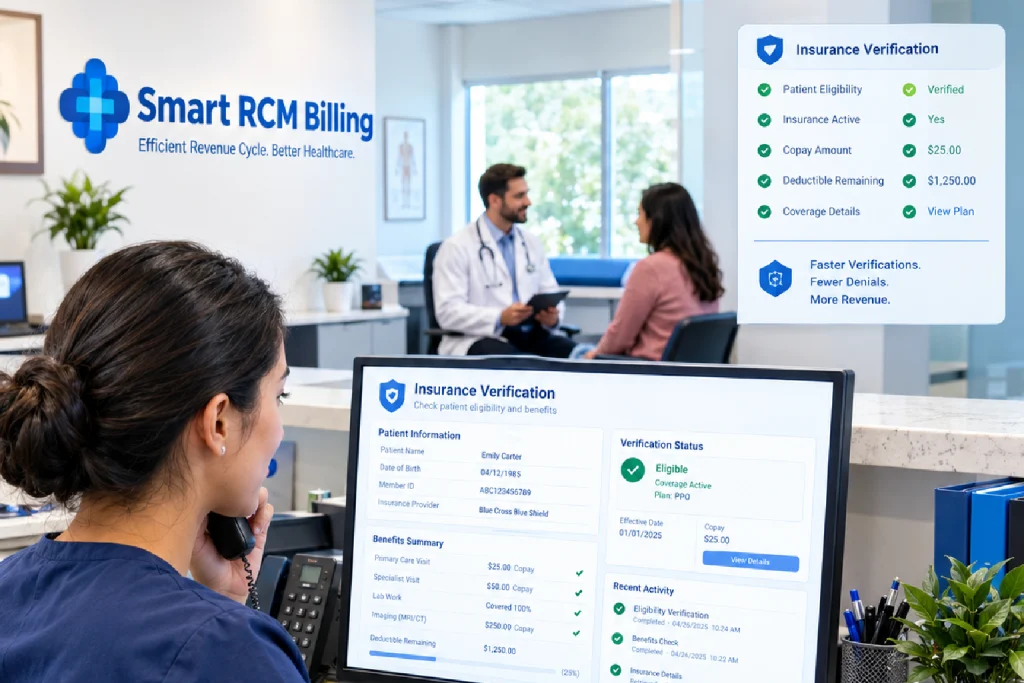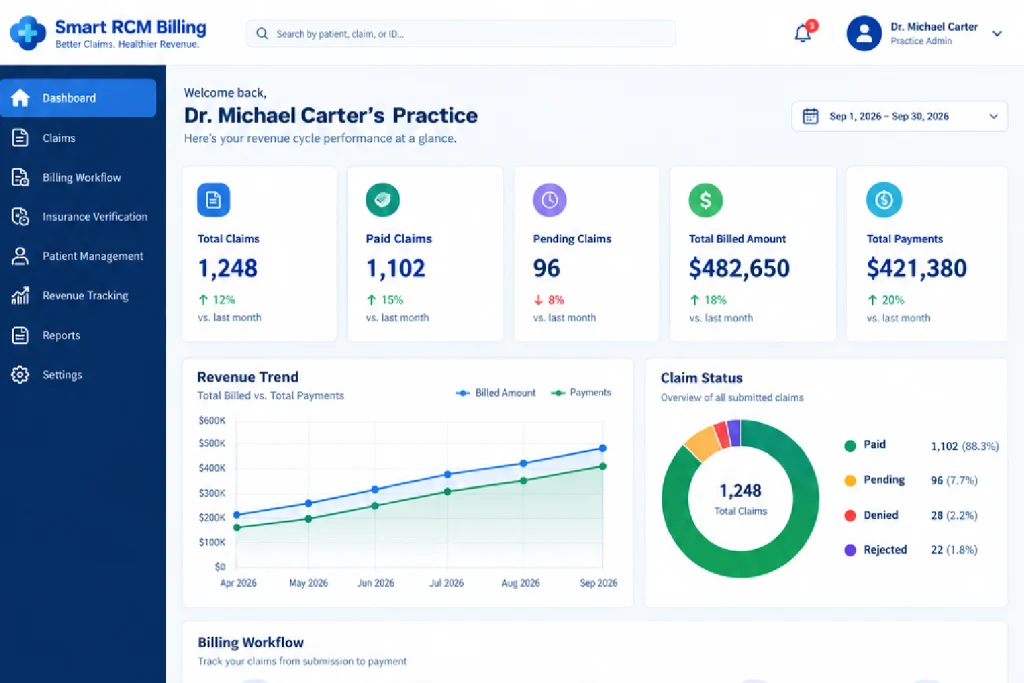
If your practice is busy but revenue is not growing, billing inefficiencies may be contributing.
Most practices do not lose money because they treat too few patients. They lose it quietly, one denied claim, one missed deadline and one unanswered insurance call at a time. Choosing the right medical billing company in Florida can help address these challenges.
This guide explains very easily what a good medical billing company actually does, which numbers to ask about, what Florida makes harder, and which contract traps to avoid. No jargon wall. Just what you need to make a smart decision.
Why good practices still lose money
Picture this. A patient is seen, the visit goes well, and the claim goes out. Two weeks later it comes back denied because of a missing code or an expired insurance plan. Your front desk is already busy, so the claim goes into a pile. By the time anyone looks at it again, the insurance company’s deadline has passed. That money is gone for good.
This can happen when claims are not reviewed and followed up promptly.
Unverified industry figures sometimes suggest first-time denial rates for in-house billing can reach double digits, and a share of denied claims may never be corrected and resubmitted.
Over a year, that adds up to a serious amount of lost revenue for a single practice.
The fix isn’t working harder. It’s having a system that checks claims before they leave and follows up on every denial until it’s paid or properly closed.
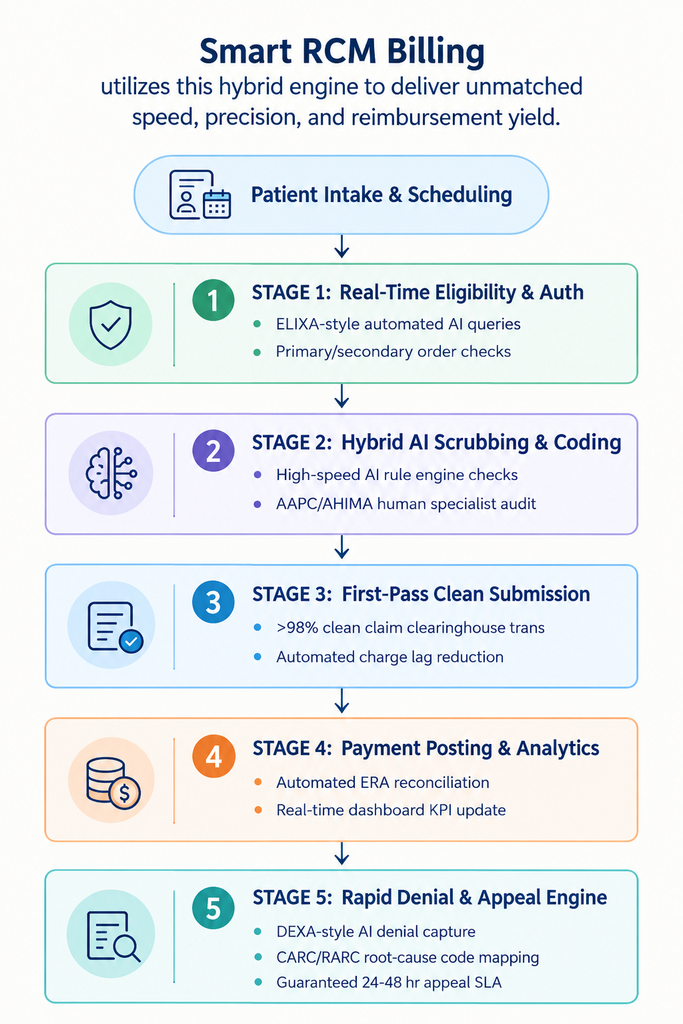
The Medical Billing Process
- Verify Insurance – Confirm patient eligibility, coverage, and authorization requirements.
- Review Claims – Check codes, modifiers, and documentation for accuracy.
- Submit Claims – Send clean claims promptly to the appropriate payers.
- Post Payments – Record payments and monitor collections and A/R.
- Resolve Denials – Investigate denials, submit corrections or appeals, and follow up until resolution.
The 5 numbers every practice owner should know
Think of these as your practice’s financial vital signs. Ask any billing company (including us) to show you their real numbers for each one. The targets below are commonly cited reference points; actual benchmarks depend on specialty, payer mix, and how each metric is calculated.
| Metric | What it means in plain English | A healthy target (context-dependent) |
| Clean claim rate | How many claims are accepted the first time without errors | Commonly cited: 95%+ (top performers aim for 98%+) — depends on specialty and methodology |
| First-pass resolution | How many claims get paid on the first submission, no rework | 90% or higher |
| Net collection rate | Of the money you’re allowed to collect, how much you actually collect | Commonly cited: 95%+ — depends on payer mix and calculation method |
| Days in A/R | How many days, on average, it takes to get paid | Commonly cited: under 35, ideally closer to 30 — depends on specialty and payer mix |
| Denial rate | How many claims insurance refuses | Commonly cited: under 5–10%, and falling — definitions vary by payer and specialty |
If your current biller can’t tell you these five numbers this week, that’s a red flag on its own.
Software alone vs. a real billing partner
Many practices buy billing software and hope for the best. Software is useful, but it’s a tool, not a team. It won’t call an insurance company, write an appeal letter, or notice that a payer quietly changed its rules last month.
Here’s the difference in practice:
| Software only | Full-service billing partner | |
| Who checks the codes? | Your staff, on top of their other work | Certified coders (AAPC / AHIMA credentialed) |
| Who fixes denials? | Whoever has time | A dedicated team with a set turnaround |
| Who tracks insurance rule changes? | You | Your billing partner |
| Cost | Software fees plus staff salaries and training | A percentage of collections or a defined service fee — the exact structure, inclusions, and additional charges should be spelled out in the contract. |
The best setup is technology plus people: automation catches the quick, repetitive errors, and trained humans handle the tricky stuff like modifiers, medical necessity and appeals.
What makes Florida billing harder
Florida has specific billing requirements, particularly around PIP, LOP cases, Medicaid managed care, and Medicare Advantage, that add complexity to an already detailed process.
A billing company must also understand applicable state-specific requirements.
Here’s what to ask about.
1. Car accident claims (PIP)
Florida’s no-fault system has strict timing requirements. In general, patients must receive initial treatment within 14 days of an accident to access benefits, and additional statutory conditions and deadlines may apply. Claims must also follow set fee schedules and paperwork rules. Miss the window or the paperwork and the claim may be denied. Verify the current statutory requirements before relying on any specific rule.
Ask your biller: Do you check the accident date at registration and make sure the required physician documentation is attached before the claim goes out?
2. Letters of Protection (LOP)
When a patient is treated under a Letter of Protection in an injury case, Florida law (Section 768.0427) addresses disclosures in personal injury or wrongful-death litigation, including itemized bills and certain disclosures in that specific context. The same requirements may not apply to every LOP billing situation, and practices should verify the applicable legal requirements with counsel. Sloppy records can hurt your claim later in court.
Ask your biller: Can you track every LOP case and produce clean, itemized statements?
3. The No Surprises Act
Federal rules limit what patients can be billed for out-of-network emergency care and certain care at in-network facilities. Different dispute processes have their own separate deadlines; the applicable process and current requirements should be confirmed for each situation.
Ask your biller: Who tracks the dispute deadlines and keeps the consent paperwork on file?
4. Medicare rules for Florida (First Coast)
Florida’s Medicare contractor, First Coast Service Options, publishes coverage rules that say which diagnoses support which services. If your claim doesn’t match, it may be denied depending on the claim and applicable coverage requirements.
Ask your biller: Are these rules built into your checks before the claim is sent?
5. Medicaid managed care plans
Florida Medicaid runs through managed care plans such as Sunshine Health, Simply Healthcare and Molina. Each plan has its own authorization, claim submission, and appeal requirements, which vary by plan and service.
Treating them all like regular insurance is a fast way to get rejections.
Ask your biller: Do you keep separate rules for each plan?
6. Snowbirds and Medicare Advantage
Florida has a large senior population, and many patients are seasonal residents who switch plans or move between states. A big share of Florida’s Medicare patients are on Medicare Advantage plans, which each have their own rules. Eligibility and plan details can change between visits, so coverage that was valid earlier in the year may not still apply.
Ask your biller: Do you verify insurance 24 to 48 hours before every visit?
How a good billing process actually works
Forget the buzzwords. A strong process has five simple steps:
- Check insurance before the visit. Confirm coverage, copays and any needed authorizations so problems are caught at the front door.
- Review the claim before sending. Software flags errors; a certified coder checks codes, modifiers and documentation.
- Send clean claims fast. Aim to submit within 24 to 48 hours of the visit when workflow and claim requirements allow.
- Post payments and watch the numbers. Payments may be matched automatically depending on system integration and configuration, and reporting dashboards show A/R, collections, and denials when supported.
- Investigate each denial, correct issues where appropriate, and appeal when supported by the circumstances. Then address the underlying cause so it doesn’t recur.
Denial follow-up is an important step and a key area where many billing companies differ in the depth of work they provide.
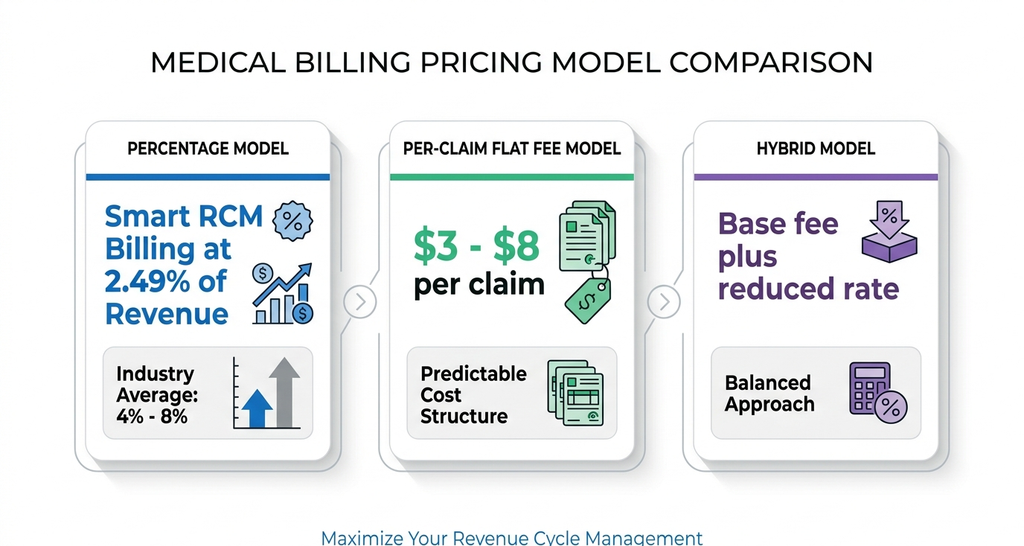
How billing companies charge (and what to watch for)
| Pricing model | Typical range | Good to know |
| Percentage of collections | Roughly 4% to 8%, depending on size and specialty | The percentage applies to collected amounts, so incentives depend on the contract’s fee structure, scope of work, and collection definitions. |
| Per-claim fee | Roughly $3 to $8 per claim | Biller is paid whether or not the claim gets paid. Evaluate per-claim pricing alongside the scope of denial follow-up and appeal services to understand the total value. |
| Hybrid | Small base fee plus lower percentage | Can suit larger or more complex groups. |
Red flags to walk away from
- A suspiciously low percentage. If it sounds too good to be true, look for extra charges: statements, reports, clearinghouse fees, appeals.
- Flat per-claim fees for complex specialties. A biller paid $5 per claim has little reason to spend hours fighting a denied $3,000 surgery claim.
- Long contracts with no exit. Look for month-to-month terms or a clause that lets you leave if agreed targets are missed, and also review termination notice periods, transition assistance, and responsibility for unresolved claims and outstanding A/R.
- Forced software changes. You should not have to drop your current EHR to work with a billing partner.
- No promised turnaround on denials. If the contract doesn’t define denial review and follow-up timelines, ask for those commitments to be spelled out in the service agreement.
- No signed BAA. A Business Associate Agreement is required by HIPAA before anyone handles patient data, so confirm the relationship and applicable HIPAA obligations and require a signed BAA where appropriate.
How Smart RCM Billing compares to other billing companies
No single billing company is perfect for everyone, so here is a quick, honest side-by-side of five companies that serve Florida practices. Use it as a starting point, then ask each one the questions in the checklist below. Competitor details can change; verify staffing, service coverage, and review availability against reliable sources and confirm the date of the information before comparing.
| Company | Pros | Cons |
| Smart RCM Billing | AAPC/AHIMA-certified codersWorks with your existing EHRTransparent pricing (specific structure per contract)Live performance dashboardFlorida-specific billing expertise | Fewer bilingual billers and virtual assistants |
| Transcure | Billing and credentialingSupports 32 specialtiesNationwide service | Quote-based pricing |
| One Source Medical Billing | Florida-based providerClaims and denial follow-upPatient billing support | Smaller team (10–49 staff)Large practices should confirm capacity |
| MGSI | Tampa-based, established in 2000Billing and credentialingEMR and accounting support | Pricing not publicly listedLimited public customer reviews |
| PracticeForces | Clearwater-based, founded in 2003Billing and codingCredentialing and EHR support | 30+ specialtiesPublic pricing not foundWritten quote required |
Why Smart RCM Billing stands out: Its combination of Florida-specific billing knowledge, existing-EHR compatibility, transparent pricing, and live performance tracking gives practices clear points of differentiation.
Smart RCM Billing Pricing: Smart RCM Billing offers transparent, practice-focused pricing based on your specialty, claim volume, and billing needs. Whether you run a small private practice or a growing multi-provider clinic, our flexible pricing helps you access reliable billing support without unnecessary overhead. Request a free billing review to discuss your practice’s needs and receive a tailored quote with no hidden fees.
Questions to ask a billing company
Copy these questions and ask every company you talk to:
- What are your clean claim rate, denial rate and days in A/R for practices like mine? Can I see them in writing?
- Are your coders certified (AAPC or AHIMA)?
- Do you have experience in my specialty?
- How quickly do you work denials?
- Do you work inside my current EHR?
- Is your pricing fully listed, with no hidden fees?
- Can I see my numbers any time through a live dashboard?
- Will you sign a BAA and name your HIPAA compliance officer?
- What does Florida experience look like for you (PIP, LOP, Medicaid plans, snowbirds)?
- What happens if you miss your targets?
Frequently asked questions
What’s the difference between medical billing and medical coding?
Coding turns what the doctor did into standard codes (diagnosis and procedure codes). Billing takes those codes, sends the claim, collects payment and follows up on denials. They work together, and mistakes in either one cost you money.
Will Florida Medicaid plans slow down my cash flow?
They can, if they’re handled like regular insurance. Each plan has its own authorization and billing rules. A billing company that understands plan-specific requirements can help reduce avoidable rejections and administrative backlogs.
Do I have to change my EHR to work with a billing company?
No. A good partner works inside the system you already use. Be cautious of anyone who insists you switch.
How do I know a billing company is HIPAA compliant?
Ask for a signed BAA, the name of their HIPAA compliance officer, proof of staff training, encrypted data transfer, and ideally an independent security audit such as SOC 2.
How soon will I see results after switching?
Results depend on your starting performance, specialty, payer mix, and transition scope. Some practices may notice early improvement within 30 to 60 days as old denials are worked and new claims go out cleaner; fuller results often take 60 to 90 days or longer.
Conclusion
The right billing partner isn’t the cheapest one or the one with the flashiest sales deck. It’s the one that shows you real numbers, understands Florida, works inside your current systems, and aligns its incentives with yours through the agreed fee structure.
Want to see where your practice stands? Request a free billing review from Smart RCM Billing and we’ll show you where money may be slipping away.