Running a healthcare practice involves much more than providing excellent patient care. Behind every patient visit is a financial process that includes insurance verification, charge capture, medical coding, claim submission, payment posting, denial management, and accounts receivable follow-up.
When these processes are not managed efficiently, revenue can become delayed or lost.
That is why medical billing and revenue cycle management (RCM) have become essential components of a financially healthy healthcare practice.
For practices that want to reduce administrative workload, improve claim accuracy, and maintain a more consistent cash flow, an organized revenue cycle can make a significant difference.
What Is Medical Billing?
Medical billing is the process of converting healthcare services into claims that are submitted to insurance companies or other payers for reimbursement.
The process typically involves:
- Patient and insurance information
- Charge entry
- Medical coding
- Claim preparation
- Claim scrubbing
- Electronic claim submission
- Payment posting
- Insurance follow-up
- Denial management
- Patient balance management
Accurate medical billing helps ensure that the services documented by healthcare providers are translated into appropriate claims and submitted with the information required by the payer.
However, medical billing is only one part of the larger financial process.
What Is Revenue Cycle Management?
Revenue cycle management encompasses the complete financial journey of a patient encounter, beginning before the appointment and continuing until the healthcare provider receives appropriate payment.
A typical RCM workflow can include:
- Patient registration
- Insurance eligibility verification
- Prior authorization when required
- Charge capture
- Medical coding
- Claim submission
- Claim tracking
- Payment posting
- Denial management
- Accounts receivable follow-up
- Patient billing and collections
- Financial reporting
The U.S. Department of Health and Human Services recognizes billing, claims management, eligibility determination, and reimbursement-related activities as part of healthcare payment activities.
Medical Billing vs. Revenue Cycle Management
Medical billing and RCM are closely connected, but they are not exactly the same.
Medical billing primarily focuses on preparing, submitting, and following up on claims so healthcare providers can receive reimbursement.
Revenue cycle management takes a broader approach by managing the financial workflow from patient registration and eligibility verification through final payment and reporting.
For example, a claim can be coded correctly and submitted successfully but still experience a payment delay because eligibility was not verified correctly before the patient’s visit.
This is why looking at the entire revenue cycle can reveal problems that are not visible when a practice focuses only on claim submission.
Where Can Revenue Leakage Occur?
Revenue leakage can happen at almost any stage of the healthcare revenue cycle.
1. Eligibility Errors
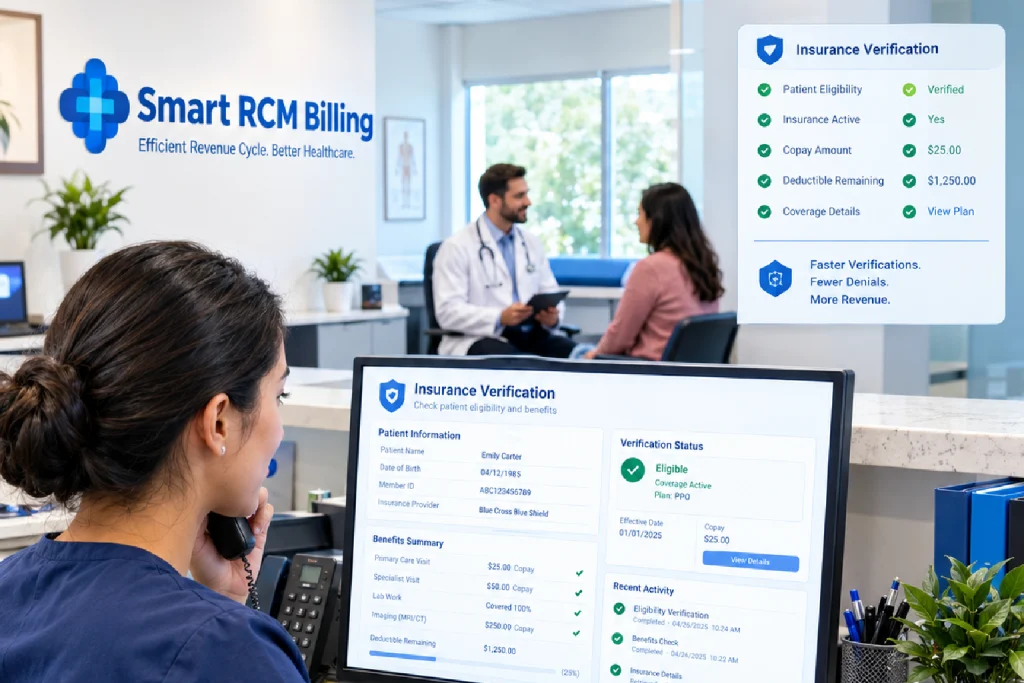
If insurance coverage is not verified correctly, a practice may provide services without knowing whether the patient’s coverage is active or whether specific authorization requirements apply.
2. Coding Errors
Incorrect CPT, HCPCS, ICD-10, or modifier selection can create claim problems, payment delays, or underpayment.
3. Missing Charges
Services that are documented but not captured correctly can result in lost reimbursement opportunities.
4. Claim Denials
Repeated claim denials can increase administrative work and delay revenue. More importantly, recurring denials can indicate an underlying workflow problem that needs to be addressed.
5. Aging Accounts Receivable
Unpaid claims that remain in A/R for extended periods require consistent follow-up. Without a structured process, older claims can become increasingly difficult to recover.
6. Patient Balance Collection Gaps
Copays, deductibles, and other patient responsibilities also form part of the revenue cycle and require accurate statements and consistent follow-up.
How Professional RCM Support Can Help
A comprehensive RCM strategy can help healthcare practices coordinate multiple financial processes instead of treating each task as an isolated activity.
Smart RCM Billing provides services across the revenue cycle, including medical billing, medical coding, insurance eligibility verification, prior authorization, denial management, A/R follow-up, provider credentialing, and healthcare virtual assistance.
This type of integrated approach can help practices:
- Reduce administrative workload
- Improve claim accuracy
- Identify recurring denial patterns
- Maintain consistent A/R follow-up
- Improve visibility into financial performance
- Support more organized billing workflows
- Give providers more time to focus on patient care
Why Specialty-Specific Billing Matters
Not every healthcare specialty has the same billing requirements.
Primary care practices may deal with E/M services, preventive care, chronic-care programs, and recurring patient visits. Cardiology practices may handle complex procedures, modifiers, authorization requirements, and specialty-specific coding. Smart RCM’s specialty services also address areas such as orthopedics, behavioral health, family medicine, internal medicine, surgery, pediatrics, dermatology, urgent care, and pain management.
Understanding the workflow and billing challenges of a particular specialty can help identify problems more effectively.
Technology and Human Expertise Should Work Together
Modern RCM relies heavily on technology, but technology alone does not replace knowledgeable billing and coding professionals.
Healthcare practices need systems that provide visibility into claims, A/R, denials, payments, and performance while experienced professionals review exceptions, investigate payer issues, and manage complex billing situations.
Smart RCM describes its model as combining technology-driven workflows with dedicated billing, coding, A/R, and credentialing professionals.
What Should a Practice Measure?
A practice cannot improve what it does not monitor.
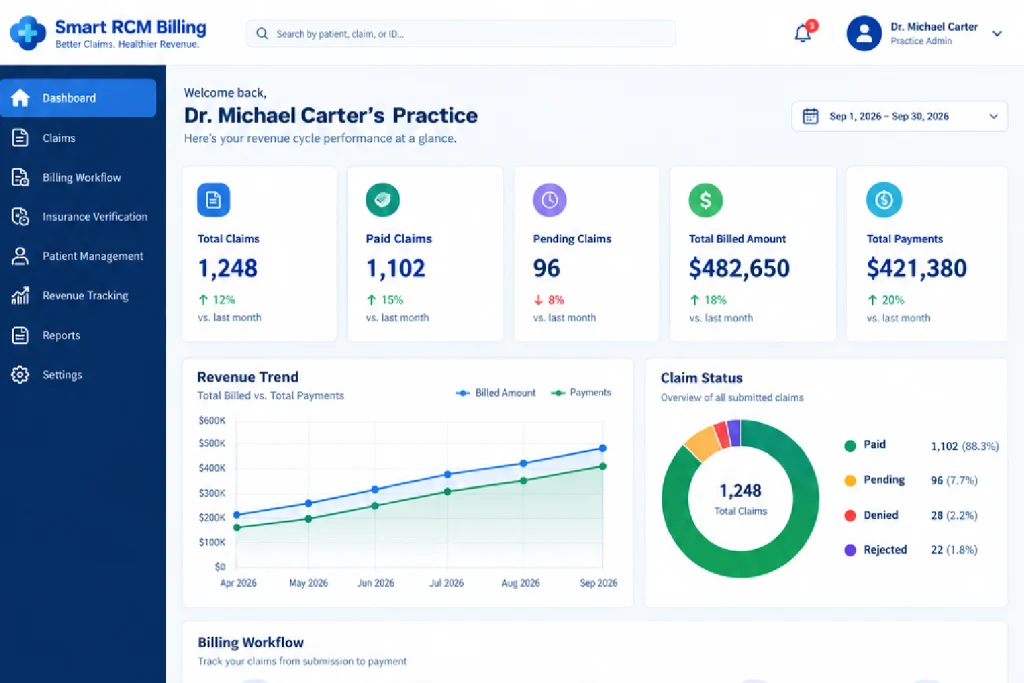
Important revenue-cycle metrics can include:
- Clean claim rate
- First-pass acceptance
- Claim denial rate
- Days in A/R
- A/R aging
- Net collection performance
- Payment turnaround
- Denial reasons
- Underpayments
- Outstanding patient balances
Reviewing these metrics regularly can help practices identify where revenue is getting delayed or where processes need improvement.
Final Thoughts
Medical billing is an important part of healthcare administration, but a healthy revenue cycle requires much more than submitting claims.
Eligibility verification, authorization, coding, claim submission, payment posting, denial management, A/R follow-up, and reporting all work together.
When these processes are connected and monitored consistently, healthcare practices can gain greater visibility into their financial operations while reducing unnecessary administrative pressure.
For practices evaluating their current billing workflow, a medical billing and A/R assessment can be a practical starting point for identifying revenue-cycle opportunities.
Need Help With Your Revenue Cycle?
Smart RCM Billing provides medical billing and revenue cycle management support for healthcare practices across multiple specialties. From billing and coding to denials, eligibility verification, prior authorization, and A/R follow-up, the goal is to create a more organized and transparent revenue cycle.