A patient has an appointment.
The clinical team provides the appropriate care.
The claim is submitted.
Then the practice receives a denial because the patient’s coverage was inactive, the benefits did not cover the service, or an authorization requirement was not identified.
This type of situation can create unnecessary administrative work and delay reimbursement.
That is why insurance eligibility verification should be an important part of the medical billing workflow.
Before providing services, healthcare practices need a reliable process for confirming patient coverage, benefits, eligibility, and applicable payer requirements.
What Is Insurance Eligibility Verification?
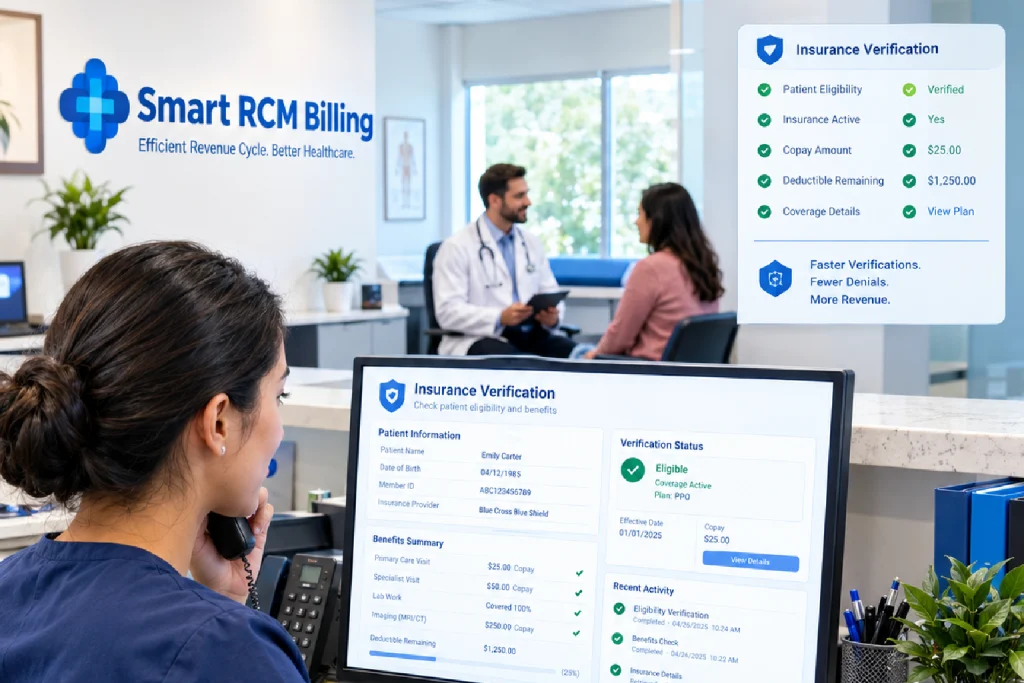
Insurance eligibility verification is the process of confirming whether a patient’s health insurance coverage is active and determining relevant benefit information before healthcare services are provided.
Depending on the payer and service, verification may involve reviewing:
- Patient demographic information
- Member ID
- Insurance plan
- Coverage status
- Effective dates
- Deductible
- Copayment
- Coinsurance
- Out-of-pocket responsibility
- Benefit limitations
- Referral requirements
- Authorization requirements
- Network status
The goal is to give the practice accurate information that can support registration, scheduling, billing, and patient communication.
The U.S. Department of Health and Human Services includes determining eligibility or coverage and adjudicating claims within healthcare payment activities under HIPAA.
Why Is Insurance Verification Important?
Eligibility verification can influence several parts of the revenue cycle.
1. It Can Help Reduce Eligibility-Related Denials
If coverage information is outdated or incorrect, the claim may encounter problems after services have already been provided.
Checking eligibility before the appointment gives the practice an opportunity to identify discrepancies earlier.
2. It Helps Practices Understand Patient Responsibility
Patients may have deductibles, copayments, coinsurance, or other financial responsibilities.
Accurate benefit information can help the practice communicate expected patient responsibility more clearly.
3. It Supports Accurate Claim Submission
Correct payer and patient information can help reduce avoidable errors during claim preparation.
4. It Supports Better Front-Desk Workflows
When eligibility information is available before the visit, front-office staff can spend less time reacting to coverage problems after the encounter.
5. It Connects Directly to Revenue Cycle Management
Eligibility verification is not an isolated administrative task.
It is an early stage of the revenue cycle that can affect authorization, charge capture, claims, patient billing, and collections.
What Should Be Verified?
A thorough eligibility workflow should go beyond simply asking whether a patient has insurance.
Patient Information
Confirm that the patient’s demographic information matches the payer’s records.
Coverage Status
Determine whether the insurance plan is active for the date of service.
Benefits
Review applicable benefits for the service being provided.
Patient Responsibility
Where available, identify relevant deductible, copayment, and coinsurance information.
Network Status
Determine whether the provider or facility is participating with the patient’s plan when applicable.
Authorization Requirements
Some services may require prior authorization or other payer approval.
Referral Requirements
Certain plans or services may have referral requirements that should be identified before treatment.
Eligibility Verification and Prior Authorization Are Not the Same
These two processes are often discussed together, but they serve different purposes.
Eligibility verification determines whether a patient’s coverage is active and helps establish applicable benefits and requirements.
Prior authorization is the process of obtaining payer approval for certain services when authorization is required.
A patient can have active insurance coverage while a specific service still requires prior authorization.
That distinction is important because verifying active coverage does not automatically mean every service will be reimbursed without additional payer requirements.
Smart RCM Billing offers both insurance eligibility verification and prior authorization services, allowing these functions to be addressed as connected parts of the revenue cycle.
Common Eligibility Verification Problems
Incorrect Member Information
Even small discrepancies in member information can create claim-processing problems.
Coverage Changes
Patients may change employers, plans, or insurance carriers without the practice immediately receiving updated information.
Inactive Coverage
A plan may have been active previously but inactive on the date of service.
Multiple Insurance Plans
Patients may have primary and secondary coverage that needs to be coordinated correctly.
Benefit Limitations
Active coverage does not necessarily mean that every service is covered under the same terms.
Authorization Requirements
Some services require additional payer approval even when coverage is active.
Why Real-Time Verification Matters
Healthcare practices operate in an environment where insurance information can change.
For this reason, relying exclusively on information collected weeks or months earlier may not provide an accurate picture of a patient’s coverage on the date of service.
Smart RCM Billing’s insurance eligibility service emphasizes real-time eligibility and benefits verification before patient visits.
A consistent verification workflow can help practices identify potential issues earlier rather than discovering them after claims have already been submitted.
How Eligibility Verification Supports Revenue Cycle Management
Consider the revenue cycle as a connected chain:
Registration → Eligibility → Authorization → Documentation → Coding → Claim Submission → Payment → Denial Management → A/R Follow-Up
A problem at the eligibility stage can create consequences later in the process.
For example:
Incorrect insurance information → Claim submission → Payer rejection/denial → Rework → Appeal or correction → Delayed payment → Increased A/R
The earlier the issue is identified, the more opportunities the practice has to correct it.
Should Practices Outsource Insurance Verification?
Outsourcing eligibility verification can be useful for practices that have:
- High patient volumes
- Limited front-office staffing
- Frequent eligibility-related denials
- Multiple insurance plans
- Complex specialty workflows
- Difficulty maintaining consistent verification processes
- Staff shortages during busy periods
Smart RCM Billing states that its eligibility verification services support primary care, specialty practices, hospitals, and medical billing companies, with workflows designed to integrate with common EHR and practice-management systems.
Whether outsourcing makes sense depends on the practice’s workload, systems, staffing, and operational requirements.
Protecting Patient Information During Verification
Insurance verification involves sensitive healthcare and patient information.
Healthcare organizations and their business associates must consider applicable HIPAA requirements when handling protected health information. HHS explains that business associates can include organizations performing billing and other services involving protected health information and that appropriate safeguards and business associate arrangements may apply.
For this reason, practices should evaluate not only speed and accuracy but also the security and compliance processes used by any external billing or verification partner.
How to Improve Your Eligibility Verification Workflow
Healthcare practices can strengthen their process by:
- Verifying insurance before scheduled visits.
- Rechecking coverage when appropriate.
- Confirming patient demographics.
- Reviewing benefits and patient responsibility.
- Identifying authorization and referral requirements.
- Documenting verification results.
- Updating the practice-management system.
- Communicating relevant financial information to patients.
- Monitoring eligibility-related denials.
- Reviewing recurring problems and correcting the workflow.
Final Thoughts
Insurance eligibility verification is one of the earliest opportunities a healthcare practice has to prevent avoidable billing problems.
Accurate verification can support cleaner claims, better patient communication, more efficient front-office workflows, and a more organized revenue cycle.
It should therefore be treated as an important part of the practice’s overall financial process rather than simply an administrative checkbox.
Improve Your Insurance Verification Workflow
Smart RCM Billing provides insurance eligibility verification services designed to help healthcare practices verify coverage and benefits, identify potential issues, and support a smoother revenue cycle.
If eligibility-related denials or front-office workload are affecting your practice, a workflow assessment can help identify opportunities for improvement.