A medical claim denial is more than an administrative inconvenience.
Every denied claim can create additional work for billing staff, delay reimbursement, increase accounts receivable, and potentially create revenue leakage for a healthcare practice.
The challenge becomes even greater when the same denial reasons continue appearing month after month.
Effective medical claim denial management is therefore not simply about appealing individual claims. It is about identifying why claims are being denied, correcting the underlying problems, and creating workflows that help prevent recurring denials.
What Is Medical Claim Denial Management?
Medical claim denial management is the process of identifying, analyzing, correcting, appealing, tracking, and preventing denied healthcare claims.
A structured denial management process generally includes:
- Identifying the denial
- Reviewing the payer’s denial reason
- Determining the root cause
- Correcting the claim when appropriate
- Submitting an appeal or corrected claim
- Following up with the payer
- Recording the outcome
- Identifying patterns
- Correcting the underlying workflow
This last step is especially important.
Recovering one denied claim solves one problem. Understanding why dozens of similar claims are being denied can solve a much larger operational problem.
Common Causes of Medical Claim Denials
Denials can occur for many different reasons, and the exact causes vary according to specialty, payer, service, documentation, and practice workflow.
Insurance Eligibility Problems
A patient’s insurance coverage may be inactive, changed, or different from what was recorded during registration.
Eligibility verification before the encounter can help identify coverage issues before services are provided.
Prior Authorization Issues
Some services may require payer authorization before they are performed.
When required authorization is missing, expired, incorrect, or does not match the service performed, reimbursement can be delayed or denied.
Coding Errors
Incorrect diagnosis codes, procedure codes, modifiers, or code combinations can create claim problems.
Accurate medical coding and documentation review are therefore important components of denial prevention.
Documentation Problems
Claims can be affected when documentation does not adequately support the services billed.
Clinical documentation and coding should work together so the submitted claim accurately reflects the documented service.
Duplicate Claims
Submitting the same claim more than once can create duplicate-claim denials and additional administrative work.
Timely Filing Issues
Payers establish filing deadlines. Claims submitted after applicable deadlines may be denied, making timely claim submission and follow-up important.
Medical Necessity Issues
Some payer decisions depend on whether the documentation and submitted information support the medical necessity of the service under the applicable coverage policy.
Why Repeated Denials Are a Bigger Problem
Suppose a practice repeatedly receives denials for the same reason.
The billing team can continue correcting and resubmitting individual claims, but that approach treats the symptom instead of the underlying problem.
A better approach is to ask:
- Which payer is generating the denials?
- Which service is involved?
- Which provider or location is affected?
- Which denial reason code appears most often?
- Is the problem related to registration, eligibility, authorization, coding, documentation, or claims submission?
- How much revenue is tied to the recurring denial?
- How long are these claims remaining in A/R?
This type of analysis can reveal patterns that individual claim reviews may miss.
The Analyze, Appeal, and Prevent Approach
Smart RCM Billing’s denial-management positioning focuses on three connected stages: Analyze, Appeal, and Prevent.
Analyze
Start by understanding the denial.
Review the payer response, claim information, coding, documentation, eligibility, authorization, and other relevant details.
The goal is to determine the actual reason the claim was not paid as expected.
Appeal
Once the reason is understood, the billing team can determine the appropriate next step.
Depending on the situation, that may involve:
- Correcting the claim
- Providing additional documentation
- Submitting an appeal
- Communicating with the payer
- Resubmitting the claim
- Escalating unresolved payer issues
Prevent
The final step is preventing the same issue from occurring again.
For example, if repeated denials are caused by an authorization workflow problem, simply appealing the claims does not address the root cause.
The practice should improve its authorization workflow so future claims are less likely to encounter the same problem.
How Denial Management Supports A/R
Denied claims often become part of the accounts receivable workload.
Without consistent follow-up, claims can remain unresolved and increase the age of the practice’s A/R.
An effective denial management program should therefore connect directly with A/R follow-up.
Smart RCM Billing’s RCM approach includes denial analysis, claims and A/R cleanup, payer follow-up, appeals, and payment posting as connected parts of the revenue cycle.
What Should Practices Track?
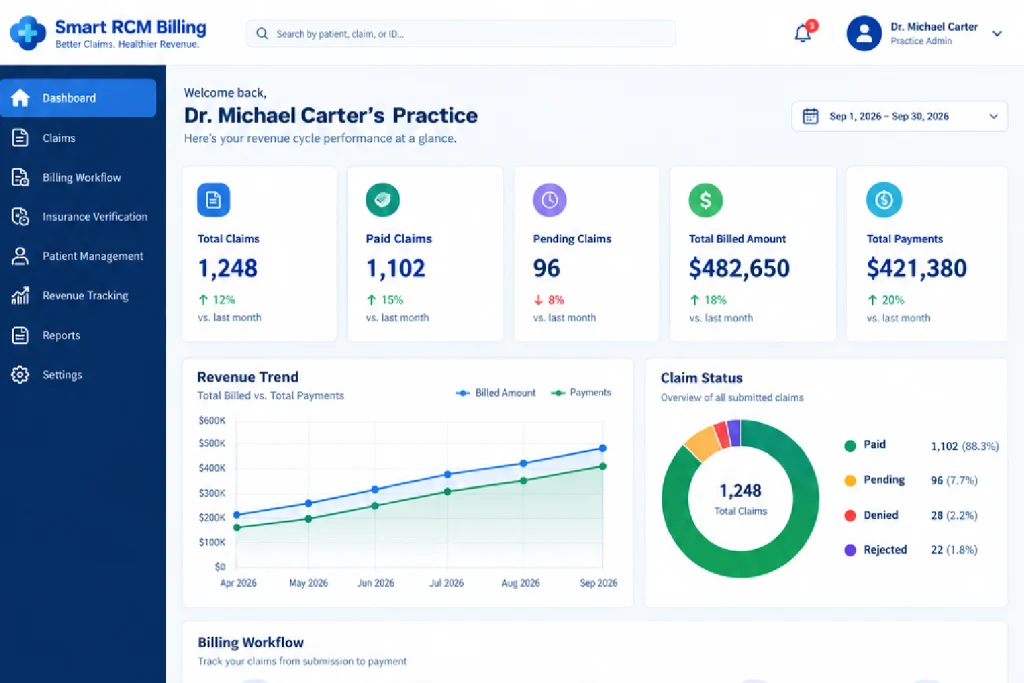
A denial-management dashboard should provide more than a total denial count.
Useful metrics can include:
- Overall denial rate
- Denial rate by payer
- Denial rate by specialty
- Denial rate by provider
- Denial rate by procedure
- Denial reason codes
- Dollar value of denied claims
- Appeal success rate
- Average resolution time
- Repeat denial rate
- A/R associated with denials
Tracking both claim volume and dollar value is important.
A practice may have a large number of small denials and a smaller number of high-value denials. Both matter, but they may require different priorities.
Why Specialty Knowledge Matters
Denial patterns can differ significantly between specialties.
For example, Smart RCM identifies authorization and medical-necessity issues in cardiology, modifier and documentation issues in orthopedics, eligibility and visit-limit issues in behavioral health, and procedure authorization and coding issues in pain management.
This is why denial management should not always be treated as a one-size-fits-all process.
Prevention Starts Before Claim Submission
One of the most effective ways to manage denials is to prevent avoidable problems before the claim reaches the payer.
A preventive workflow may include:
Patient Registration → Eligibility Verification → Authorization → Documentation → Coding → Claim Scrubbing → Claim Submission → Payment Posting → Denial Monitoring → A/R Follow-Up
Each stage creates an opportunity to identify potential problems before they become expensive.
When Should a Practice Consider Outsourcing Denial Management?
Outsourcing may be worth evaluating when:
- Denied claims are accumulating
- A/R is aging
- Billing staff lack time for detailed appeals
- Denial reasons are not being analyzed
- Payer follow-up is inconsistent
- The same denial patterns continue
- The practice lacks specialty-specific billing expertise
- Internal staffing shortages are affecting collections
The right approach depends on the practice’s size, payer mix, claim volume, specialty, internal resources, and existing technology.
Final Thoughts
Medical claim denial management should not be viewed simply as a process for fixing rejected claims.
It should be part of a broader revenue-cycle strategy designed to identify problems, recover appropriate reimbursement, and prevent recurring issues.
By combining denial analysis, accurate coding, eligibility verification, authorization management, timely appeals, and consistent A/R follow-up, healthcare practices can build a more proactive approach to revenue protection.
Need Help With Denial Management?
Smart RCM Billing provides denial management and appeals support designed to help healthcare practices analyze denial patterns, pursue appropriate reimbursement, and address recurring billing problems.
A denial assessment can help identify where claims are getting stuck and which areas of the revenue cycle deserve attention first.